


 Knee Replacement Surgery
 Knee Replacement Surgery
If you are reading this, chances are you have spent months, or maybe even years, managing nagging knee pain. You have tried the ice packs, the anti-inflammatories, the physical therapy, and the cortisone shots. But if your world is shrinking because your knee refuses to cooperate, robotic knee replacement surgery is likely the next logical step for you.
It is completely normal to feel a mix of hope and anxiety. The best way to replace anxiety with confidence is through information. Whether you are discussing a traditional approach or exploring advanced technology like a robotic knee replacement, the key to a successful outcome starts with open communication.
When you sit down with your orthopedic surgeon, you are not just there to listen; you are asking them to ensure you get the absolute best results for your lifestyle.
To help you navigate this important decision, Bapashri Hospital has categorized the crucial questions into five essential areas. From choosing your surgeon and understanding the robotic procedure to navigating risks, managing the day of surgery, and planning your recovery, these categories provide a clear roadmap to help you make informed decisions.
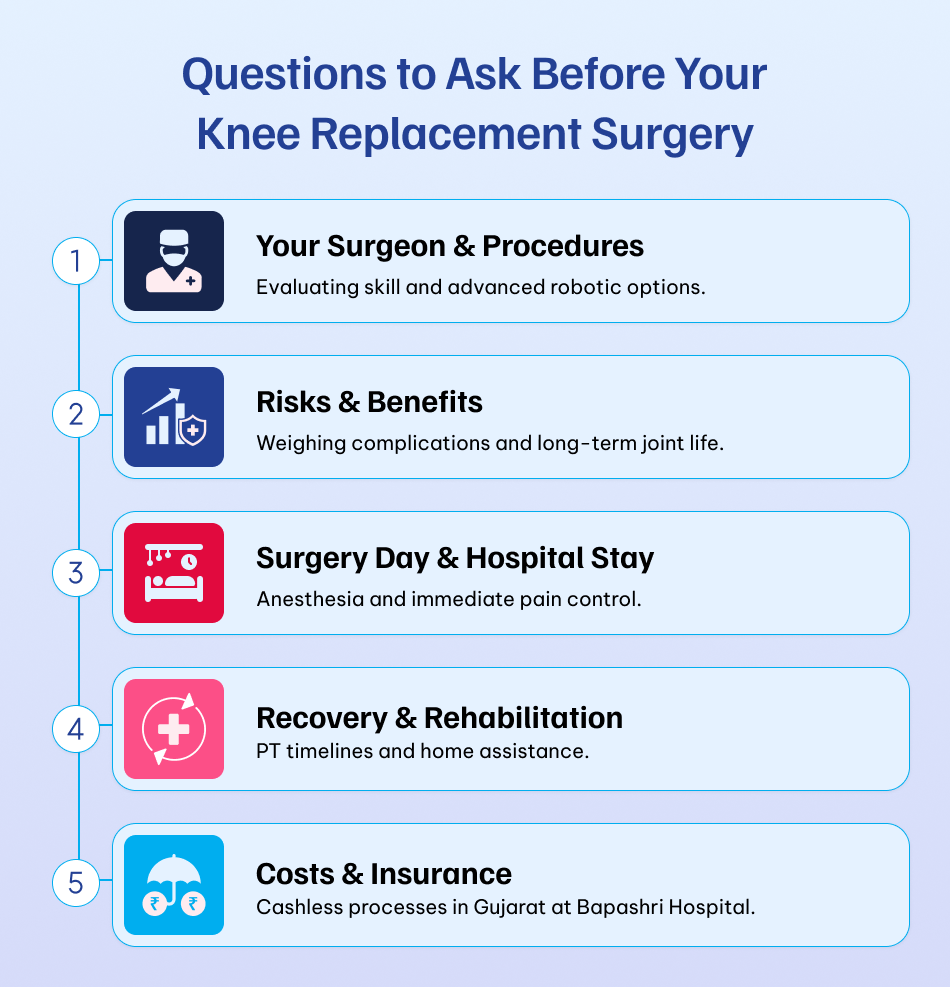
Questions for Your Orthopedic Surgeon
Think of your first consultation as a collaborative strategy session. A great surgeon will not just look at your X-rays; they will look at your life goals. Slide these four questions across the desk during your appointment:
Am I eligible for knee replacement surgery?
Not all knee pain requires total surgery. Your doctor should clearly explain why your specific joint damage, whether from osteoarthritis, rheumatoid arthritis, or a past injury, necessitates replacement over more conservative management.
Which type of knee replacement do you recommend, and why?
Ask whether you need a Total Knee Replacement (TKR) or a Partial Knee Replacement (PKR); this is also the perfect time to ask if you are a candidate for a robotic knee replacement. Robotic-assisted surgery offers greater precision, potentially leading to better alignment and a more natural-feeling joint.
If you are looking for premier care, finding the best robotic knee replacement hospital in Gujarat is key. Leading facilities, such as Dr Jay Patel Bapashri Hospital, utilize real-time robotic tracking to tailor the procedure to your exact anatomy. Ensure your surgeon explains the rationale behind their technical approach so you feel confident moving forward.
What materials/implants will be used, and how long do they typically last?
Knee implants are made of high-grade medical metals and durable plastics. Ask about the specific brand or design they plan to use. Modern implants are incredibly sophisticated and typically last 15 to 20 years. Still, it is vital to know what is going into your body and its expected lifespan based on your personal activity level.
How many of these specific surgeries do you perform each year?
You want a specialist who performs knee replacements routinely, not occasionally. If you are planning to undergo robotic knee replacement surgery in Gujarat, ask how many procedures the surgeon has completed using that specific robotic system. Don’t be shy about asking this; a seasoned professional will welcome the question.

Ready to take your first step toward a pain-free life?
Questions About Risks, Benefits, and Outcomes
Making a confident decision means weighing the potential upside against the realities of a major procedure. Your surgeon should help you paint a realistic picture of your post-surgery life and explain how advanced options like a robotic knee replacement alter these dynamics:
What are the success rates for a patient of my age and activity level?
Success is not just a generic percentage; it is highly individual. A younger, active patient has different expectations (such as returning to hiking or golf) than someone whose main goal is climbing stairs pain-free. Ask your doctor how modern techniques, specifically a precision-guided robotic knee replacement, can optimize implant placement to match your expected lifestyle and activity levels.
What are the potential complications, and how do we prevent them?
Every surgical procedure carries risks, such as blood clots, stiffness, or infection. Instead of avoiding the topic, address it head-on. Ask your surgeon how the minimized soft-tissue disruption of a knee replacement affects your risk profile and what standard protocols, like blood thinners or compression stockings, they use alongside it.
What is the lifetime expectation of this new knee?
Modern implants are highly resilient and typically last 15 to 20 years. However, incorrect alignment is a primary cause of premature wear. Ask your doctor how the sub-millimeter tracking accuracy of a robotic knee replacement protects the implant from uneven friction, helping to ensure your new joint stands the test of time.
Questions About the Day of Surgery & Hospital Stay
The “unknowns” of the actual hospital stay are often where patient anxiety peaks. Knowing exactly how your surgical team manages the details of your robotic knee replacement procedure will help you feel completely in control.
Will I need general anesthesia or a regional nerve block?
Many modern knee replacements are performed using spinal or regional nerve blocks combined with light sedation, rather than full general anesthesia. This means waking up feeling less groggy, experiencing better immediate pain management, and experiencing fewer systemic side effects, such as nausea.
How long will I be in the hospital?
Thanks to minimally invasive techniques and advanced engineering, modern surgery has shorter hospital stays than ever. Many patients who undergo a knee replacement walk within hours and are discharged within 1 to 2 days, with some even qualifying for same-day outpatient care. Find out what your specific timeline looks like so your family can plan.
What is the plan for immediate post-op pain management?
You should never have to endure severe pain. Ask your surgeon about their pain management approach. Advanced knee replacement techniques, combined with nerve blocks and targeted medications, help reduce discomfort and support early mobility after surgery.
Questions About Recovery and Rehabilitation
Recovery after knee replacement surgery varies from person to person, but having a clear understanding of the rehabilitation process can help you set realistic expectations and prepare for a smoother recovery. Whether you are considering traditional surgery or robotic knee replacement, discussing recovery goals with your surgeon can help you better understand the rehabilitation process.
How soon will I start physical therapy?
Physical therapy typically begins within 24 hours of surgery, often while you are still in the hospital. Early exercises focus on improving circulation, reducing stiffness, and helping you safely stand and walk. Your physical therapist at Bapashri will gradually introduce strengthening and range-of-motion exercises as you recover.
Will I need at-home care or a rehabilitation facility?
Many patients can return home within one or two days after surgery and continue recovery with the support of family members and outpatient physical therapy. However, patients who live alone, have limited mobility, or have certain medical conditions may benefit from additional home-care support.
What will my mobility look like 2 weeks, 6 weeks, and 3 months after surgery?
At around two weeks, most patients can walk short distances with a walker or cane and perform basic daily activities. By six weeks, many people are walking more comfortably with minimal assistance and can manage routine tasks independently. Around three months after surgery, patients often experience significant improvements in mobility, strength, and overall function, although recovery continues beyond this point.
When can I safely drive, return to work, and resume hobbies?
Most patients can walk short distances with a walker or cane within two weeks. By six weeks, many regain independence in daily activities, and by three months, significant improvements in mobility and strength are typically achieved.
Questions Regarding Costs and Insurance
Investing in your health should not mean guessing about your finances. Understanding the cost structure and navigating insurance policies is essential to making a final decision with total confidence.
While the Insurance Regulatory and Development Authority of India (IRDAI) mandates that standard health policies cover modern treatments, it is crucial to clarify how your specific plan handles advanced technology. Take control of the financial details by asking these major questions:
Does my insurance provider fully cover robotic knee replacement?
Most health insurance plans in India cover knee replacement when it is medically necessary. However, advanced technologies may have coverage limits, so check with your insurer or hospital to confirm any potential out-of-pocket costs.
What out-of-pocket costs should I anticipate?
Even with a solid insurance plan, there can be minor non-medical expenses, consumable charges, or room rent differences if you choose a private room category that exceeds your policy limits. Additionally, ask about the costs of post-surgery physical therapy and any assistive devices (e.g., a walker or crutches) you will need at home so you can budget clearly.
Do you offer a seamless cashless approval process?
To avoid insurance-related stress, choose a hospital that works directly with your insurer or TPA and offers on-site insurance assistance. For robotic knee replacement surgery in Gujarat, completing pre-authorization 48–72 hours before admission can help ensure a smooth cashless treatment experience from admission to discharge.

Don’t let knee pain decide your future.
A Quick Checklist
Preparing your home before knee replacement surgery can make recovery safer, more comfortable, and less stressful. Since mobility may be limited during the first few weeks, making a few simple adjustments in advance can help reduce the risk of falls and make daily activities easier.
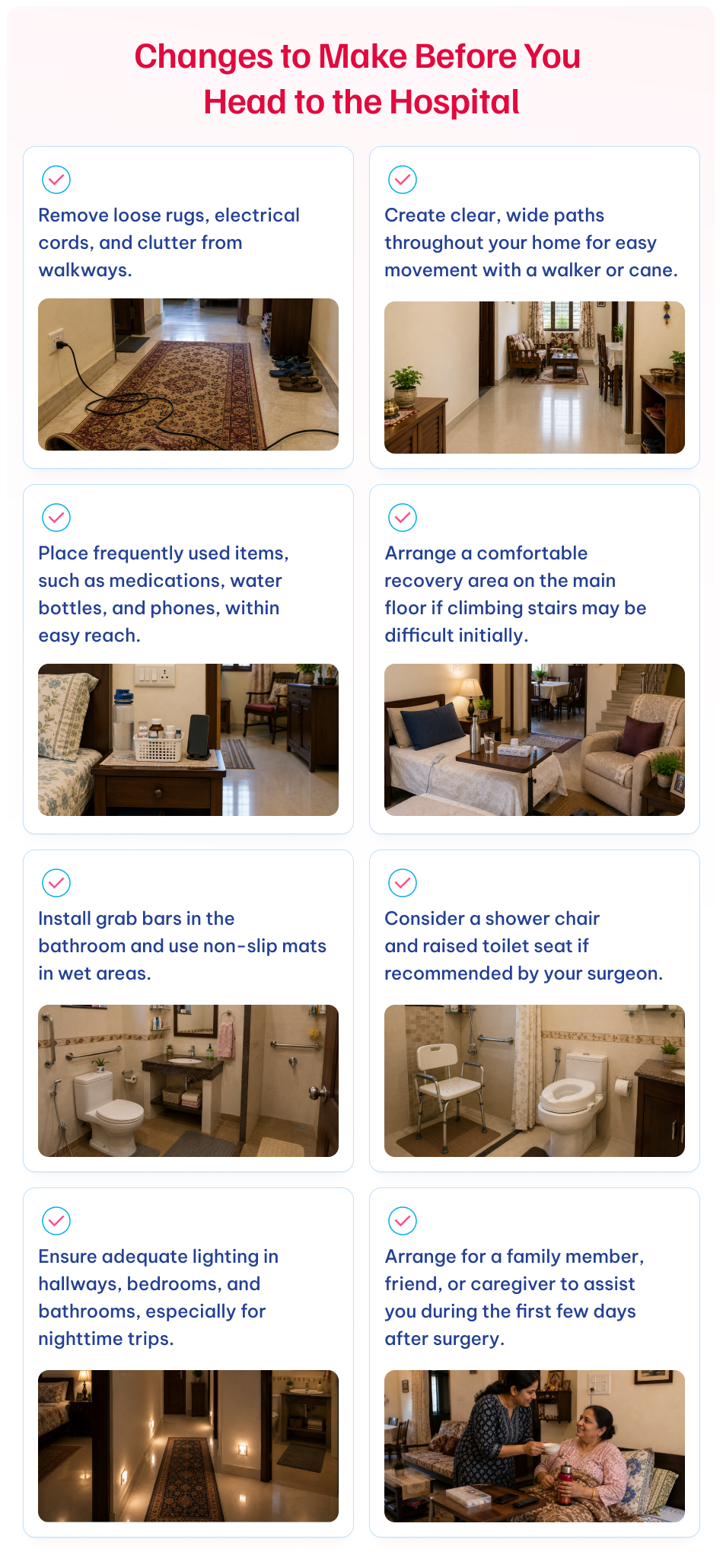
Taking these steps before knee replacement surgery can help you focus on healing and make your transition from the hospital to home much smoother.
Conclusion
Deciding to undergo surgery is never easy, but it is one of the most profoundly empowering choices you can make for your future. Remember, you are choosing to reclaim your mobility, your independence, and your quality of life.
By walking into your consultation armed with these questions, you transition from a passive patient to an active, informed person in your own healthcare journey. Whether you ultimately choose a traditional approach or decide that the precision of a robotic knee replacement is the right path for you, having these open, honest conversations with your surgical team will replace anxiety with confidence.
FAQ
How soon can I travel by air or go on a long road trip after a robotic knee replacement?
For long car rides or flights, most surgeons recommend waiting 4 to 6 weeks post-surgery. Sitting still for prolonged periods increases the risk of blood clots. However, it is best to take advice from your knee replacement surgeon before you decide to travel.
Will my new robotic knee set off airport security metal detectors?
Yes, it likely will. Modern knee implants are made of metal alloys (such as titanium) that set off sensitive airport scanners. You do not need a special doctor’s note or medical card, as security teams are highly trained for this. Simply inform the security officer that you have a joint replacement before walking through, and they will likely guide you to a 3D body scanner.
Can I get an MRI scan in the future if I have a robotic knee implant?
Yes, absolutely. Modern joint implants are made of non-ferromagnetic materials, meaning they are entirely safe for MRI. However, the metal can cause slight visual blur in the immediate area around the knee on the scan. Always inform your radiologist beforehand so they can adjust the MRI settings to get a clear image.
Is it normal to feel a clicking sensation or numbness in the knee after surgery?
Both are incredibly common and usually entirely harmless! A soft clicking sound is often just the high-tech metal and plastic parts tapping against each other as the joint moves—this is completely normal. Minor skin numbness on the outer side of your incision is also common because tiny skin nerves are inevitably moved during surgery.
Can I kneel after a total or partial knee replacement?
While kneeling will not damage or break your new robotic knee replacement, it can feel uncomfortable or unusual at first due to scar tissue and altered sensation. Your physical therapist will give you specific exercises to help desensitize the area so you can gradually return to household tasks or floor-based activities.